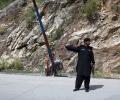
India has clearly conveyed to Pakistan that the entire union territories of Jammu and Kashmir and Ladakh, including the areas of Gilgit and Baltistan, are an integral part of the country by virtue of its fully legal and irrevocable accession.

Phunchuk Stobdan's forte was candour and strong views on India's defence. Naturally, India's adversaries were in awe of him, fearing his views and unyielding stand on boundary issues, remembers Tarun Vijay.

Pakistan perceives that if it had declared Gilgit-Baltistan, PoK or both, which are only a part of the territories of J&K, as legitimate provinces of Pakistan it would weaken its case for the entire J&K and lead to legal complications, observes Lieutenant General Syed Ata Hasnain (retd).
'The president of the Islamic Republic of Pakistan is pleased to announce Sunday, the 15th November 2020, as the poll day for the general elections to the Gilgit-Baltistan (GB) Legislative Assembly in terms of Section 57(1) of the Elections Act 2017,' the statement said. Reacting to the development, the Spokesperson of the Ministry of External Affairs Anurag Srivastava said in New Delhi said the Government of Pakistan or its judiciary has no locus standi on territories illegally and forcibly occupied by it.

Today's situation in the Shaksgam Valley is the consequence of what happened in Gilgit in 1947. But is India ready to militarily get back its territories? asks Claude Arpi.
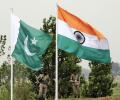
Srivastava's response came following a media query about Pakistani Prime Minister Imran Khan's comments in Gilgit on Sunday about his government's decision to accord "provisional provincial status" to the Gilgit-Baltistan region.
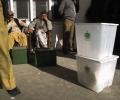
India on Tuesday flagged its objections to elections being held in Gilgit-Baltistan, which forms a part of Pakistan-occupied Kashmir, and termed the move as an attempt to camouflage the 'forcible and illegal' occupation of the region.

In a move that is bound to raise hackles in India, Pakistan is working on raising the constitutional status of its occupied Gilgit-Baltistan to address China's concerns over the $46-billion economic corridor through the strategic region.
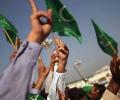
Notwithstanding India's objection, Pakistan on Monday held legislative assembly elections in the strategic Gilgit-Baltistan region amid tight security.

"Our position on the entire Union territory of Jammu and Kashmir being an integral part of India is well known. We would urge the international community to respect our sovereignty and territorial integrity," Bagchi said when asked about Blome's visit.
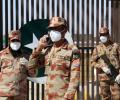
The Ministry of External Affairs said Pakistan was told that entire Jammu and Kashmir and Ladakh, including areas of Gilgit and Baltistan, are an integral part of India and that Islamabad should immediately vacate the areas under its illegal occupation.

"We are always ready for talks with Pakistan but with a caveat that terror and talks cannot go together... There cannot be a comprehensive dialogue till Pakistan shuns terror," the minister said while addressing a press conference at the completion of four years in power of the Narendra Modi-led government.

Voicing great concern over China's remarks about "India-controlled Kashmir", External Affairs Minister S M Krishna asked Beijing to respect India's sensitivities on Jammu and Kashmir which is an inalienable part of the country.

The global map printed on the new 20 Riyal banknote, released to mark Saudi Arabia's presidency of the G20 grouping, does not feature Jammu and Kashmir and Ladakh as part of India.

India on Saturday released fresh maps of the newly-created Union Territories (UTs) of Jammu and Kashmir, and Ladakh and the map of India depicting these UTs.

"Disappointed to see the Pakistan PM use the UN to praise a militant group that uses violence to promote its cause," Congressman Ted Poe said in a tweet.
This is for the first time the UNHRC has issued a report on the alleged human rights violations in Kashmir and PoK.

Pakistan Prime Minister Shehbaz Sharif on Thursday chose Lt Gen Asim Munir as the new Army chief to replace incumbent General Qamar Javed Bajwa.
On Thursday, maximum new cases were recorded in Balochistan where the number of infected people rose to 76 from 23. Punjab was the next where the number rose from 33 to 78, Dawn reported.

Asserting that the prime minister had been thanked by these people for flagging their cause at the all-party meeting, he added that the former was sufficiently moved by their gratitude massages.
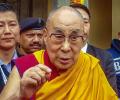
'The logical step is to challenge the very legitimacy of the Chinese claim over Tibet,' recommends Inspector General Gurdip Singh Uban (retd).

Hitting out at the report, ministry of external affairs spokesperson Raveesh Kumar said in New Delhi that the update of the earlier OHCHR report is "merely a continuation of the earlier false and motivated narrative" on the situation in Jammu and Kashmir.

'If one puts the context of what Xi Jinping said at the UN about not wanting a 'hot or cold war with any country', one realises that his speech was quite bizarre.' 'The world does not expect such statements from China, a nation aspiring to be a superpower.

In the year since Modi cast the spotlight on Pakistan's human rights violations in Balochistan, India has not done much more than raise the issue at the UN a few times.
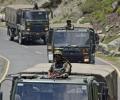
'The one aspect which no Indian military thinker would wish to see emerge is a LoC type of posture at the LAC.' 'The LoC is manned for 750 km and terrorist infiltration has led to the creation of a virtual fortress along its entire length.' 'Something mirroring this at the LAC is going to be expensive although deployment everywhere is not warranted there.' 'However, given the complete trust deficit, there appear few alternatives,' notes Lieutenant General Syed Ata Hasnain (retd).
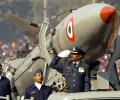
While we have to hiss loudly and do the lunging bit to keep our foes on their toes, that's only a tactical matter. What is the strategic goal? What is the end game? In my opinion, there is only one possible end game: the unwinding of Pakistan into several pieces: Balochistan, Sind, Balawaristan (Gilgit, Baltistan, the rest of PoK), the Pashtun area Khyber Pakhtunwa which will merge with Afghanistan, and the rump Punjab, says Rajeev Srinivasan.
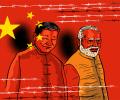
The reasons for China's negative response are located in its territorial dispute with India but also to its grand designs of dominating the region from its previous position of being merely a "balancer" between India and Pakistan, points out Srikanth Kondapalli, Professor in Chinese Studies at JNU.

In an apparent snub to India, a Russian ground forces contingent on Friday arrived in Pakistan to participate in the first-ever joint military exercises starting from Saturday.
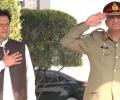
'The Modi government's grandstanding has hardened the reflexes in Beijing, Islamabad and Kathmandu and complicated India's relations with these three countries, which were even otherwise highly problematic.' 'Whatever prospects existed for a fair and balanced resolution of the territorial disputes may also have receded,' observes Ambassador M K Bhadrakumar.

'The Indian side has realised that not talking to Pakistan has not served any useful purpose.'

Two-time Pulitzer Prize winner Paul Salopek is on an intercontinental journey of 24,000 miles, tracing humankind's movement out of Africa right down to South America.

Home ministry officials told the parliamentary panel that those detained under the PSA can challenge their detention in a designated tribunal.

Just like China wants Trump to lose the US presidential poll, it may want Modi to lose the Lok Sabha polls. So months before the 2024 elections, China may take possession of an important area, say one of the Char Dhams, warns Sanjeev Nayyar.

'Modi's decision to hold out an olive branch to Sharif within 48 hours of the 'surgical strikes' has been a timely move as it helps tensions to 'de-escalate',' says Ambassador M K Bhadrakumar.
'The one thing India has over these two States, whose toughness awes us, is our ability to embrace diversity with ease. 'The way ahead lies in learning from Vajpayee's method, not in Xi Jinping's,' says Shekhar Gupta.

'While China expressed reservations on the Indian role in the South China Sea, Beijing threw to the winds Indian concerns on Kashmir by announcing $46 billion in investments Pakistan occupied Kashmir,' says Srikanth Kondapalli.
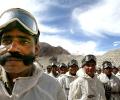
'The Indian military has rightly advised the government not to fall for the rather spurious Pakistani demand to demilitarise Siachen,' says Nitin Gokhale in an interview about his new book Beyond NJ9842: The Siachen Saga.

'How can Kashmir be demilitarised if the terrorist threat remains and Pakistan continues to incite elements in Kashmir to keep the internal situation unstable?' asks former foreign secretary Kanwal Sibal.
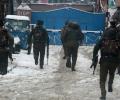
'We need to be in a perpetual state of aggression, and able to swiftly change the goal posts to keep Pakistan in a state of imbalance,' argues Sanjeev Nayyar.

How will the Modi Sarkar's likely return affect other nations?
 © 2026 Rediff.com - Advertise with us - Disclaimer - Privacy Policy - Sitemap - Feedback - About us - Terms of use - Grievances